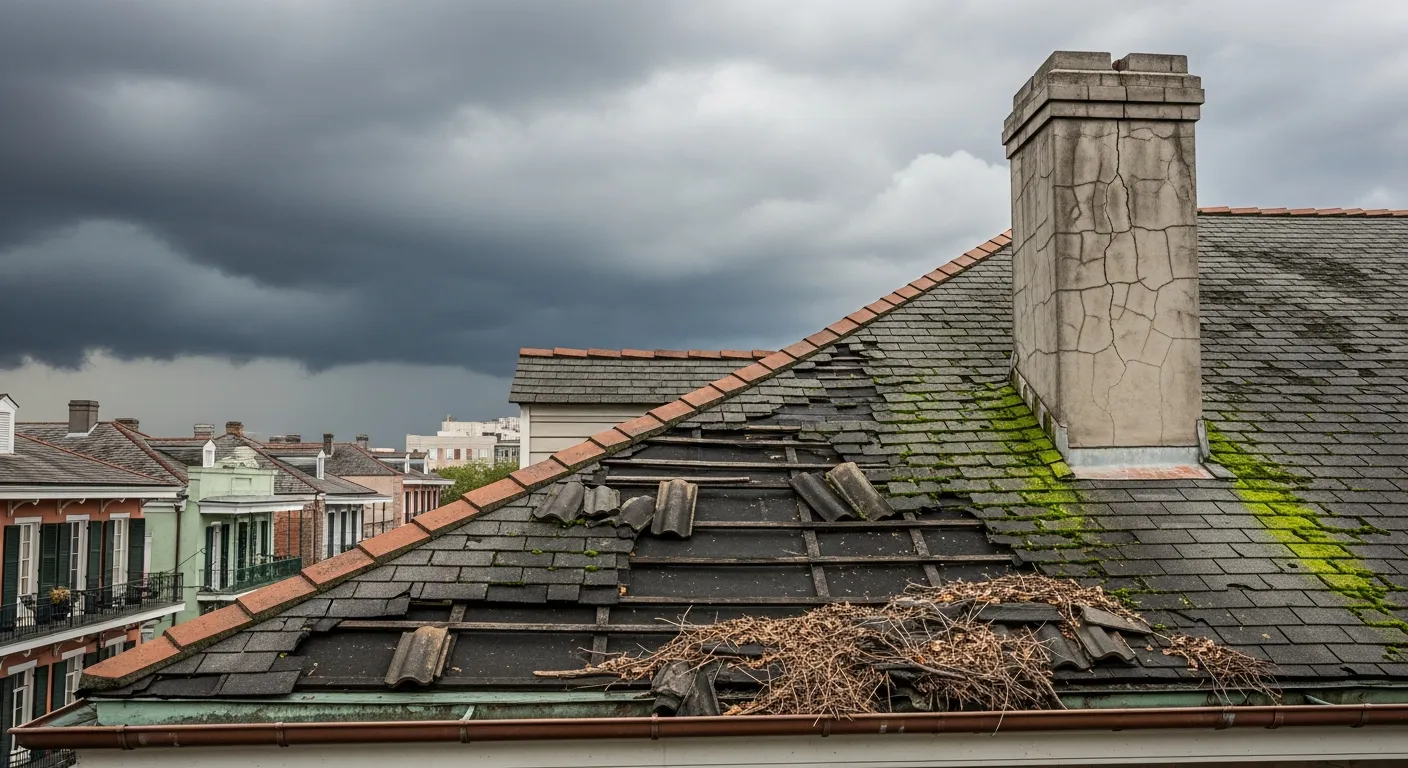
There's a particular kind of homeowner regret that shows up after every significant storm in New Orleans. It's the realization that the roof had been sending signals for months, maybe years, and nobody was up there looking. The granules in the gutter, the soft spot near the chimney, the flashing that had started to lift at the edge. Each of them, on its own, might not have seemed urgent. Together, they were an expensive problem waiting for the right weather event to announce itself.
Regular roof inspections exist precisely to intercept that pattern. They're not about generating repair work; a good inspector will tell you when nothing needs to be done. They're about knowing what you're dealing with so you can make informed decisions, not reactive ones.
What New Orleans Specifically Demands
Most roofing professionals recommend an inspection at least once a year, and twice a year in climates like New Orleans is a reasonable approach: once before hurricane season begins in June and once after it ends in November. The reasoning is straightforward - you want to enter the high-risk period knowing your roof is sound, and you want to check for any damage after the season before it has months to develop into something worse.
New Orleans also has some roof-specific challenges that make regular professional eyes valuable. The city's high humidity means that small moisture intrusions can accelerate into mold and rot faster than they would in drier climates. Properties in low-lying areas, which describes much of Orleans Parish, are also more susceptible to drainage-related issues, where water that can't move away from the structure finds its way in at the roof perimeter or through compromised flashing.
What an Inspector Is Actually Looking At
A professional roof inspection is more thorough than anything you can do from the ground or even with a ladder. An inspector will assess the condition of all shingle surfaces, looking for granule loss, cracking, curling, and blistering. They'll check every penetration point: chimneys, plumbing vents, skylights, and HVAC equipment. They'll examine all the flashing and look for separation, rust, or improper sealing.
On flat and low-slope roofs, common throughout New Orleans' older building stock, an inspector will look for ponding patterns, seam integrity, and signs of membrane degradation. They'll also evaluate the condition of the fascia and soffit, check the gutters and downspouts, and look for signs of moss or algae growth that can shorten a roof's life if left unaddressed.
The documentation that comes with a professional roof inspection in New Orleans is itself valuable. A written report with photographs creates a baseline record of the roof's condition that's useful for insurance purposes, for future buyers if you sell the home, and for tracking how the roof ages over time.
The Financial Case Is Straightforward
The math on roof inspections is not complicated. A professional inspection costs a fraction of what a significant repair costs, and a significant repair costs a fraction of what a full replacement costs. Catching a flashing problem before it lets water into the decking is inexpensive. Replacing decking that has rotted because the flashing failure went undetected for two years is not.
There's also an insurance dimension worth understanding. After a major storm, insurance adjusters are busy and timelines get compressed. Homeowners who have recent inspection documentation can often move through the claims process more efficiently, because they have a clear pre-storm baseline to point to. If your roof was inspected and certified in good condition before a storm, the damage that appears after it is much easier to attribute to the event itself.
Commercial Property Owners Have Even More at Stake
For commercial property owners in New Orleans, whether you own a retail building, a restaurant, a warehouse, or a multi-unit residential property, the consequences of deferred roof maintenance are amplified. A roof failure doesn't just mean repair costs; it means potential business interruption, tenant issues, and liability exposure if the interior is damaged.
Commercial roofs, particularly large flat membrane systems, benefit enormously from a structured inspection and maintenance program. Small seam separations and drainage problems that would be minor repairs when caught early can become full membrane replacements when they've been absorbing water for a season.
What to Expect From the Process
A professional roof inspection from a reputable company is not a high-pressure sales visit. The inspector should be focused on accurately documenting the roof's condition, explaining what they find in terms you can understand, and giving you an honest picture of what needs attention. Repairs should be recommended because they're needed, not because someone is trying to generate revenue.
If any issues are identified, you'll have the opportunity to review the findings and decide how to proceed. In some cases, that leads to a roof repair in New Orleans. In others, it's simply a note to monitor something at the next inspection. Either way, you're making decisions from a position of knowledge rather than guessing.
Schedule It Now, Not After the Storm
The irony of roof inspections is that demand spikes exactly when availability gets tight, right after a major storm, when every roofing company in the metro is fielding calls. Homeowners who schedule inspections proactively, before the season heats up, get better access to professional time and attention.
New Orleans is a city that has learned what storms can do to buildings that weren't properly maintained. An annual roof inspection is one of the most practical things a homeowner or commercial property owner can do to stay ahead of that curve. It's not expensive, it doesn't take long, and the alternative is far worse.