

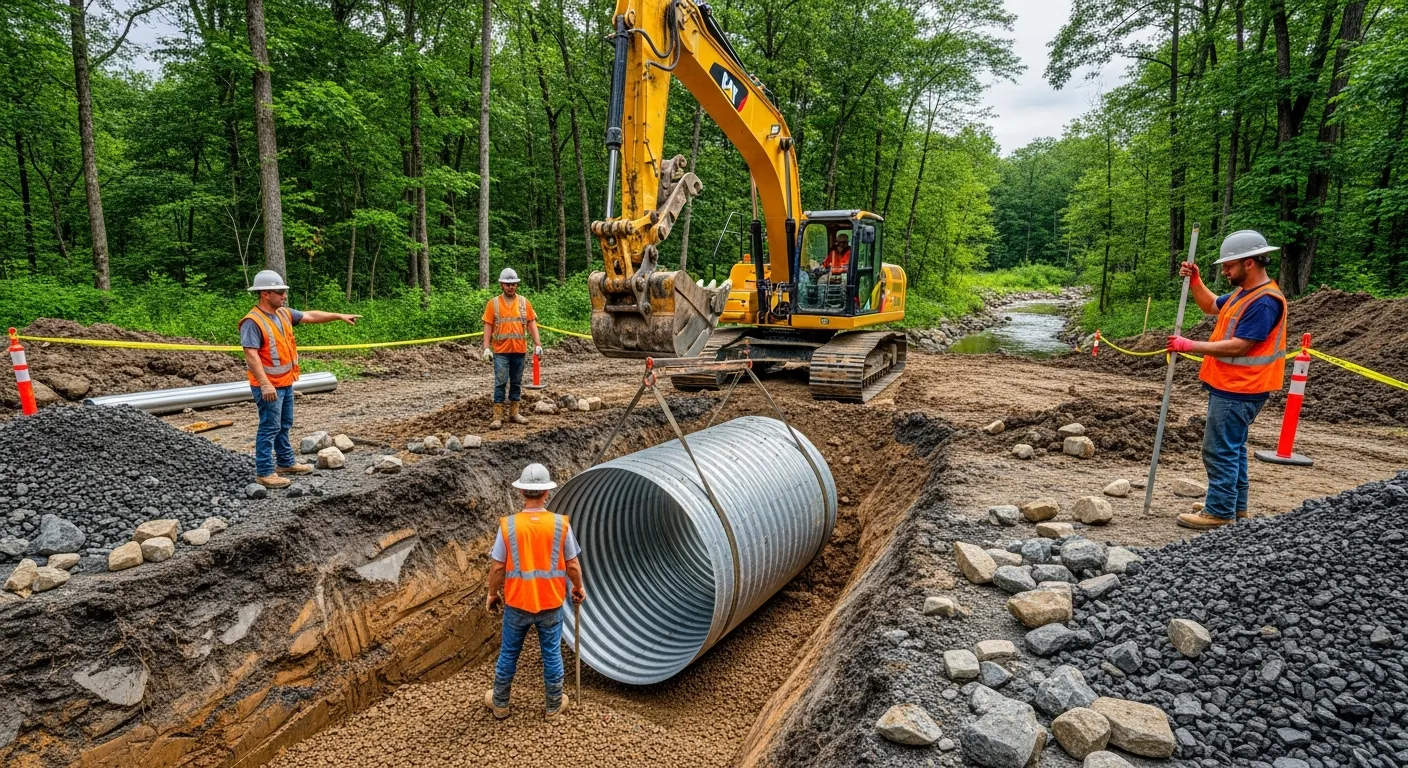
Most homeowners and property owners don't think much about culverts until there's a problem. Then suddenly this piece of drainage infrastructure that's been quietly doing its job for decades becomes a very pressing concern.
Whether yours has failed, is showing signs of deterioration, or you've been told it needs replacing as part of a property transaction or improvement project, understanding what the replacement process involves removes most of the uncertainty and lets you plan and budget appropriately.
What a Culvert Is and Why It Matters
A culvert is a drainage structure that allows water to flow beneath a road, driveway, or embankment. On residential and rural properties, culverts are most commonly found beneath driveway entrances where a drainage ditch crosses the access route. They're typically made from corrugated metal pipe, concrete, or high-density polyethylene and are sized to handle the volume of water flow that the drainage system requires.
When a culvert is functioning correctly, it's invisible to property owners. When it fails, the consequences are visible and significant: flooded driveways, erosion of the road surface above it, undermining of the surrounding embankment, and in serious cases, complete collapse of the surface over the failed pipe.
When functioning properly, culverts are part of a broader stormwater management system that helps protect roads, driveways, and surrounding properties from flooding and erosion. Their importance has grown as aging infrastructure faces increased pressure from more frequent heavy rainfall events. The American Society of Civil Engineers has highlighted the strain being placed on stormwater systems across the United States, making proactive maintenance and timely replacement of drainage structures more important than ever.
Signs That a Culvert Replacement Is Needed
Culverts have finite service lives. Corrugated metal culverts typically last 25 to 50 years depending on soil conditions, water chemistry, and the quality of original installation. Concrete culverts can last longer but are prone to cracking and joint failure over time. Plastic culverts generally have the longest service life but aren't always appropriate for all loading conditions.
Signs that a culvert assessment or replacement may be necessary include:
- Visible rust, corrosion, or holes in an exposed section of metal culvert
- Depression or soft spots in the driveway surface directly above the culvert
- Erosion or undermining at the inlet or outlet ends
- Water not draining through or draining much more slowly than it should
- A culvert that is visibly crushed, bent, or misaligned
- Age, if a metal culvert is over 30 years old and hasn't been recently assessed
For a detailed breakdown of what culvert replacement involves including cost factors and permit requirements, reading through the specifics is worthwhile before you begin planning.
ICON Grading is a Kansas City, Missouri-based excavation and site work company with direct experience in the drainage conditions, soil types, and permit requirements specific to the region, which affects the practical approach to culvert work significantly.
The Replacement Process Step by Step
Understanding what actually happens during a culvert replacement helps property owners prepare practically and make informed decisions about scope and timing.
Initial assessment. A site work professional inspects the existing culvert, assesses the drainage system it serves, measures the required pipe diameter, and evaluates the condition of the surrounding embankment and roadway surface. This assessment determines the appropriate replacement pipe material, size, and installation approach.
Permit requirements. Many culvert replacements require permits from the local municipality, county, or state department of transportation, depending on whether the affected driveway or road has any public involvement. Your contractor typically manages the permit process, but the timeline for permit approval needs to be factored into the project schedule.
Excavation. The existing driveway or road surface above the culvert is cut and removed. The surrounding embankment material is excavated to expose the full length of the existing culvert and provide adequate working space for installation.
Removal and replacement. The failed culvert is removed. The prepared bed is inspected and any soft or compromised base material is addressed. The new culvert is installed, properly bedded, and connected at both inlet and outlet ends.
Backfill and compaction. The excavated area is backfilled with appropriate material in compacted lifts to restore structural integrity to the embankment and provide a stable base for the surface restoration.
Surface restoration. The driveway or road surface is restored to match the surrounding area. Depending on the surface type and the extent of the excavation, this may involve asphalt patching, gravel resurfacing, or concrete work.
Project Duration and What Affects It
A standard driveway culvert replacement on a residential property typically takes one to two days for the physical work, assuming no complications. Factors that extend the timeline include:
- Permit processing time, which varies significantly by municipality
- Difficult site access or limited working space
- Unexpected sub-surface conditions requiring additional base preparation
- Coordination with utility locates if the work is near underground services
- Surface restoration requirements that need curing time before the area can be trafficked
Planning for the access disruption that a driveway culvert replacement creates is important, particularly for properties where the driveway is the only vehicle access.
Cost Variables Worth Understanding
Culvert replacement costs vary based on several factors that are difficult to estimate without a site assessment. The primary variables include pipe diameter and material, total pipe length, depth of installation, site access difficulty, extent of base preparation required, and the cost of surface restoration.
Getting a specific on-site assessment and quote before budgeting is the only way to get a reliable cost figure. Ballpark estimates from general sources frequently don't reflect the specific conditions of a given site.
Conclusion
A culvert replacement is a disruptive but straightforward project when managed by experienced site work professionals. Understanding the process, the permit requirements, and the timeline helps property owners plan effectively and avoid the operational and financial consequences of a culvert failure that wasn't addressed in time.


